QUANTIFYING MAGNESIUM USE IN THE AEROSPACE INDUSTRY
14 August 2026
Magnesium alloys and finished components are used in commercial aircraft, helicopters, satellites and drones, in engines, transmissions, landing gear and interiors. The aerospace magnesium alloys market was worth US$1.33 billion in 2024 and is projected to reach US$2.78 billion by 2034 (7.7% a year).
In aerospace, saving weight translates into less fuel consumption and extended range
For an aircraft, weight is everything. Magnesium is the lightest structural metal in commercial use: about 34% lighter than aluminium and 75% lighter than steel. Estimates put aircraft fuel savings at 125–165 litres a year for every kilogram of weight removed – that is 2,500–3,300 litres over a typical 20-year service life.
It also performs well on a strength-for-weight basis. Specific strength measures how much load a material carries for every kilogram of itself, so a higher number means a lighter part can do the same job. Magnesium comes in at around 158 kN·m/kg, against roughly 130 for aluminium and 38 for steel.
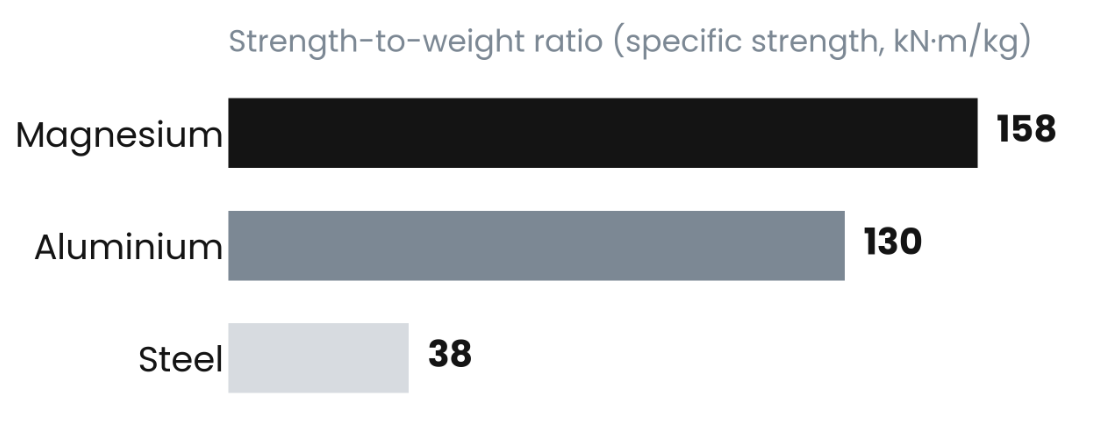
FIGURE 1 Magnesium has highest strength to weight ratio.
Where magnesium is used in the industry today
Magnesium is well established in the drivetrain and the engine. Corrosion and heat-resistant alloys such as WE43, RZ5 and ZE41 are cast into the main gearbox housings of various helicopters. These include the Black Hawk and the Boeing CH-47 Chinook. In jet engines, magnesium forms auxiliary-gearbox and generator casings: the Rolls-Royce Tay casing is a single 130 kg magnesium (MSR) part, and magnesium generator housings have flown on the Airbus A320, A350 and Concorde. Beyond the atmosphere, magnesium has provided structure for space applications such as launch vehicles and satellites. The Hubble Space Telescope also uses magnesium alloy housings to shield vital onboard digital equipment from electromagnetic interference generated by its own transmitters and power systems.
UAVs show the same lightweighting logic at a smaller scale. Magnesium is already appearing across different classes of drone. U.S. based manufacturers such as Skydio and Chinese manufacturers including DJI and Autel Robotics use magnesium in the airframe. In UAVs, where every gram affects payload, endurance and manoeuvrability, magnesium offers a useful combination of low weight, stiffness, durability and heat dissipation.
Magnesium as an alloy
Magnesium also enters aerospace indirectly, as an alloying element in high-performance aluminium. The 7xxx-series aluminium alloys used widely in aircraft, including 7050 and 7075, contain magnesium alongside zinc to produce very high-strength materials.
This can be seen across the industry’s biggest manufacturers. Boeing uses 7075 aluminium components across structural applications including wings and wing-support structures. The Boeing 777 weighs approximately 104.8 tonnes, of which around 70% is aluminium. Based on the approx. 1.2% – 3.4% magnesium content of the 2xxx and 7xxx aluminium alloys used in the aircraft, with an estimated 1,300 kg of magnesium required. This excludes the volume of dedicated magnesium components, or the magnesium needed to make the titanium alloys. Airbus has gone further with Scalmalloy, an aluminium-magnesium-scandium alloy developed by APWorks. Airbus used the material in its bionic aircraft partition, which was designed to be 45% lighter than the conventional structure.
The same principle extends into space. SpaceX’s Falcon 9 uses magnesium-bearing aluminium alloys including 6061, 7050 and 7075 in structural applications. Magnesium’s aerospace footprint is therefore larger than the visible magnesium components alone suggest: it is used both as a structural material and as an ingredient in the aluminium alloys on which modern aerospace depends.
Supply reliance
94% of global magnesium production sits in China. A single disruption at that one point reaches manufacturers worldwide, as the 2021 shortage showed, when European stocks came within weeks of running out.
Magmec is bringing low-carbon primary magnesium close to the industries that use it, from abundant, widely available feedstocks including dolomite and magnesium-rich brines. Our route to metal utilises a continuous DC-arc furnace, a more automated manufacturing process that requires less labour and energy than the widely used conventional processes currently employed.
Follow Magmec for the next article in this 3-part series, with magnesium in robotics coming soon.