QUANTIFYING MAGNESIUM USE IN ROBOTICS
7 September 2026
Before an arm can carry anything, the motors have to move the arm. Before a leg can take a step, it has to swing its own mass forward. Weight in a limb isn’t paid once. It is paid again on every movement, for the working life of the machine.
This is the third and final article in a series on the industries that depend on magnesium, following automotive and aerospace. Robotics is the newest of them, and in some ways the most unforgiving. Magnesium is the lightest structural metal produced at scale, and as humanoids move towards mass production, that single property is becoming the difference between a robot that works a full shift and one that doesn’t.
Why use magnesium in a robot?
Lighter and faster
Less mass in every limb means less strain on the motors, quicker and more agile movement, and longer run times between charges. Weight removed from a robot compounds: the structure no longer has to carry, accelerate and brake its own additional mass.
Thermal management
Magnesium conducts heat effectively, helping draw it away from the computers, power electronics and motors packed into a humanoid’s torso and joints, and helping protect sensitive electronics from overheating during prolonged operation.
Vibration damping
Magnesium has good vibration-damping characteristics compared with many other structural metals, helping suppress unwanted vibration and supporting stable, precise movement when a robot is operating at speed.
Electromagnetic shielding
A humanoid packs powerful motors, motor drives, batteries, wireless systems, processors and sensitive sensors into a remarkably small space. These electrical systems can generate electromagnetic interference (EMI) that may disrupt nearby sensing and control electronics. Magnesium housings can provide electromagnetic shielding, helping isolate sensitive components from interference generated both within the robot and by external electromagnetic sources.
Where it’s used
Magnesium is already turning up in humanoid components: neck brackets in the skeleton, battery cases, actuator bodies and motor housings. Adoption is early and much of it undisclosed, since few manufacturers publish what their machines are made of. It is worth reading the claims that do circulate carefully, because several reports of magnesium robot frames turn out to describe aluminium alloys containing magnesium rather than magnesium-based parts. Magnesium therefore enters robotics twice over: as a structural metal in its own right, and as an ingredient in the aluminium alloys alongside it.
Most of these parts are thixomoulded, a process in which magnesium is injected as a semi-solid slurry rather than poured molten. It produces thin-walled, complex and precise components, which is exactly what the compact housings of a humanoid require at scale.
How big is the emerging robotics market for magnesium?
Global humanoid shipments reached roughly 13,300 units in 2025, led by AgiBot at 5,168 units and Unitree at around 4,200. Both are Chinese, and Chinese manufacturers account for the large majority of the market. Outside China the volumes are smaller: Figure AI, Agility Robotics and Tesla each shipped about 150 humanoids in 2025, with a further 1,350 units attributed to other manufacturers globally. Beyond humanoids, Boston Dynamics has produced over 3,000 Spot units and is committed to expanding its Atlas line. The trajectory is the bigger story. Industry forecasts suggest annual humanoid sales could exceed one million units around 2030 and ten million by the mid-2030s.
What that means for magnesium depends on how much goes into each machine, and no published figure yet settles it. Take 12 kg of magnesium alloy per humanoid as a working assumption. One million robots a year would then require about 12,000 tonnes of magnesium; ten million would require 120,000 tonnes, roughly a tenth of today’s global primary production. Halve the assumption and the numbers are still substantial. Either way this is new demand arriving on top of established markets such as automotive and aerospace, not replacing them.
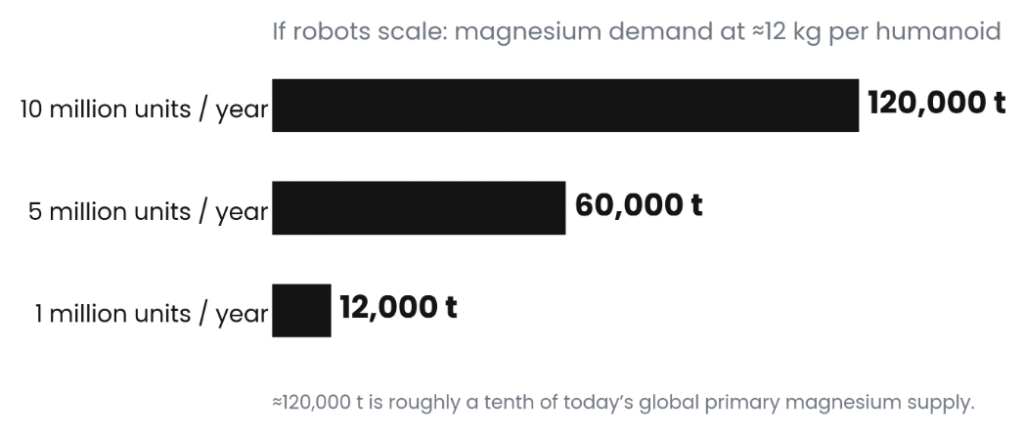
FIGURE 1 Illustrative magnesium demand from humanoid robots, on a working assumption of 12 kg of magnesium alloy per machine.
Magmec is bringing low-carbon primary magnesium close to the industries that use it, from abundant, widely available feedstocks including dolomite and magnesium-rich brines. Our route to metal utilises a continuous DC-arc furnace, a more automated manufacturing process that requires less labour and energy than the widely used conventional processes currently employed.
That concludes the series. Follow Magmec for more on magnesium and the industries that depend on it.